
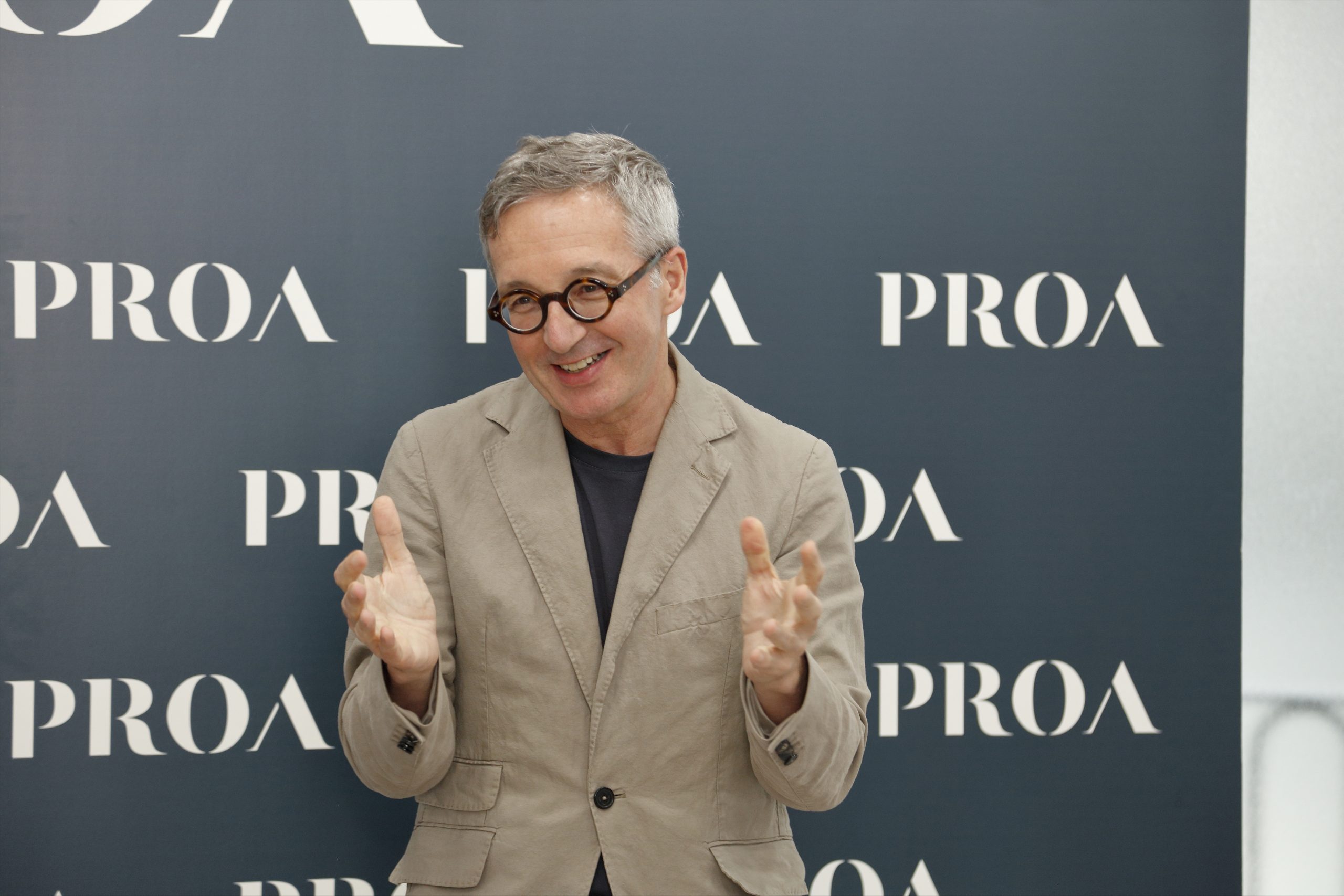
‘Meaningful AI’ was the central theme of the debate at this meeting, which was attended by leading figures from the world of business and economics, as well as from the media.
PROA Communicationa consultancy firm specialising in designing, managing and consolidating the communication and corporate reputation of institutions and companies, as well as of senior executives, has held a new edition of its Current Affairs Dialogues with the participation of José María Lassalle, consultant, writer, university professor and former Secretary of State for Culture and the Digital Agenda.
Lassalle addressed the challenges of Artificial Intelligence, not only from a technical point of view, but also focusing on the coexistence of this technology with humanism, ethics and how it will affect the emotional and professional development of our society.
At the presentation of the Current Affairs DialogueThe meeting is small and guided by rules of confidentiality, Valvanuz Serna RuizThe partner-director of PROA Comunicación, highlighted the key moment in which we find ourselves as a society, "a moment of transformation of our civilisation in which the ethical challenges related to humanism and Artificial Intelligence mean that we have to reflect in depth on the social model towards which we want to move", she pointed out.
Lassalle emphasised the need to look at AI from a different perspective, beyond the technological point of view, with a perspective that has to do with culture, anthropology and humanism. "We must be aware that it is not only a facilitating technology, it is something that has behind it a philosophy and a symbolic argument that provokes a series of tensions and uncertainties in our society", he stressed.
The former Secretary of State has unpacked the keys to the origin of AI in order to understand its current impact and the trajectory of its development. "It was born out of a desire to replicate the human brain, but without its imperfections. It is not an enabling technology, it is not a steam engine, it is something much more complex that tries to imitate the human being when it thinks", he pointed out.
Lassalle has established a direct link between AI and the current course of the economy. "Digital platforms are now replacing companies. They manage data that underpin their business model and from which conclusions are drawn to enable the sale of products or services through a futures economy that deduces and even induces behaviour".
Technology without feelings
For Lassalle, the current model of Artificial Intelligence has a "disturbing" component that began years ago with the leap to generative AI, which mimics the neural network of the human brain. "It transforms information into knowledge and, although it is artificial, it increasingly resembles the brain, although it does not want to have the capacity for error that human feelings such as pity, passion or anger provide," he added.
He also wanted to devote some space to the debate on the disappearance of the impact of this technology on the world of work, in which experts say that by 2033, 80% of current professional tasks will be taken over by AI, and 10% of jobs will disappear. In this regard, Lassalle assured that "we have years ahead of us to think about what value we can add to our tasks as humans that will make us irreplaceable to AI". We need a sense and an ethic that thinks about the purposes of AI. We have to ask ourselves what we really want it for," he added.
During the colloquium with executives from the private sector, representatives of the media and business associations, Lassalle reminded them that the use of current technology "focused on the world of screens" must be measured. For the writer and consultant, "the applications that we all use on a daily basis are designed with models based on how children play. They totally focus our attention, through scroll infinite tactile manipulation, and generate a specific toxicity, dehumanisation, which ends up producing collective problems such as mental health".
Lassalle ended his speech by stressing that, in these times of change, "it is necessary to work on emotional intelligence. Our brain experiences quantum leaps, which are difficult to explain, because it allows us to empathise with the consequences of decisions, and this differentiates us from AI", he pointed out. "We have to set limits for ourselves, that will help us to work on resilient intelligence, based on the consequences of decisions. AI will be really useful when we can ask it the questions that will then accompany the decision," he said.
The Current Affairs Dialogues PROA Comunicación brings together key figures from the economic, political, media and cultural spheres with business people, executives and opinion leaders to contribute to a deeper knowledge of reality, and to foster an in-depth understanding of the issues that lead the news agenda.