
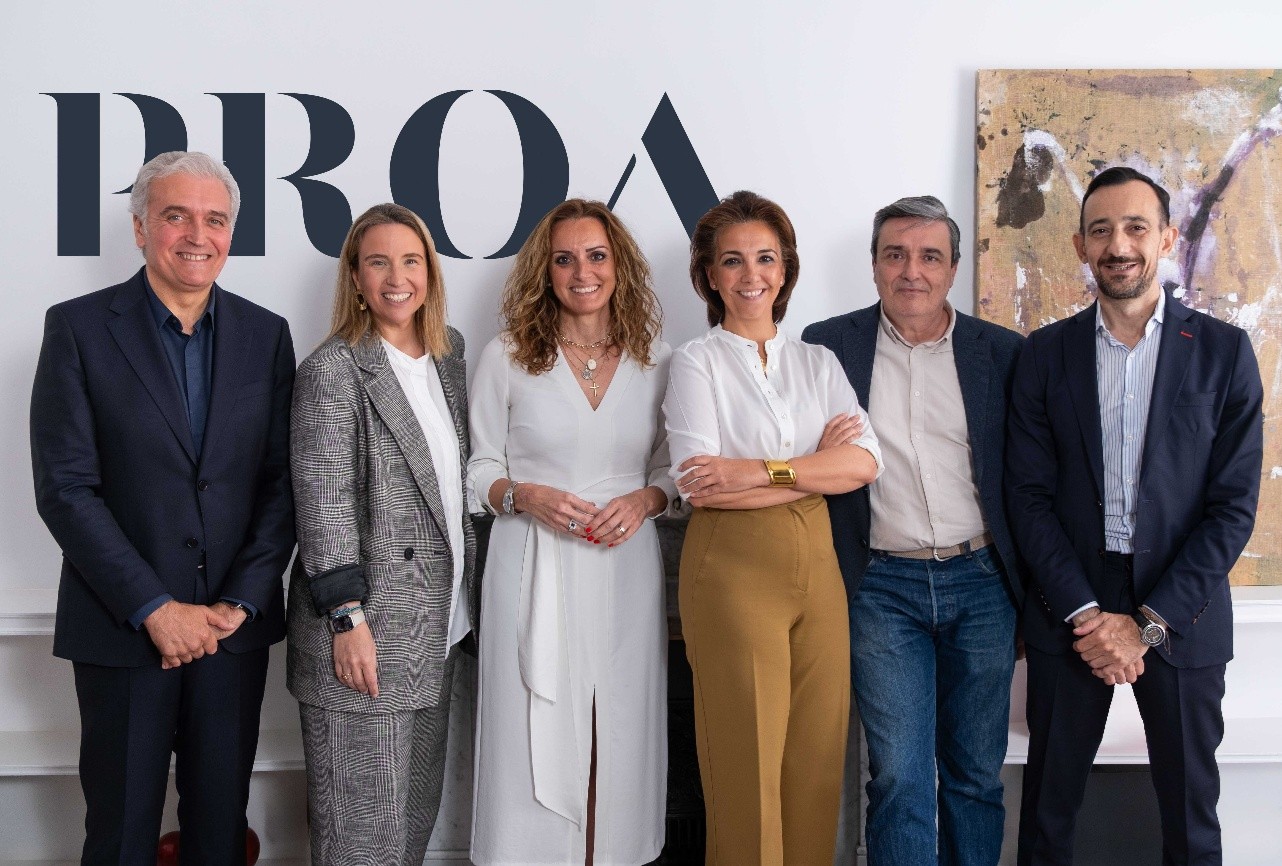
PROA Comunicación has organised a new edition of its Current Affairs Dialogues with the participation of Joaquín Mouriz (BNP Paribas Personal Finance), Fernando Geijo (Prosegur) and Patricia Peiró (Takeda), in which the strategic role of corporate communication in a context marked by uncertainty, technological transformation and the growing complexity of the reputational environment has been addressed.
The role of the communications director is currently being redefined in an environment characterised by information overload, misinformation and increasingly high expectations from various audiences. In this context, PROA Communication has held a new edition of its ‘Current Affairs Dialogues’, a forum designed to analyse the major strategic, reputational and business challenges facing organisations.
At the opening of the event, the managing partner of PROA Comunicación, Lucía Casanueva, defendió la necesidad de fomentar espacios de conversación y entendimiento en un entorno cada vez más polarizado.
“La vocación de PROA Comunicación es fomentar la concordia y el debate público saludable como vías para mejorar nuestro país”, señaló, antes de reivindicar una mayor presencia de los dircom en los órganos de decisión de las empresas.“
Decía el otro día Josep Borrell en nuestra sede que si no estás en la mesa, estarás en el menú. Pues bien, nosotros queremos que el máximo número posible de dircoms se sienten a la mesa y decidan el menú”, afirmó.
The dialogue was attended by the president of Dircom and Joaquín Mouriz, Head of Brand, Communications and Customer Experience at BNP Paribas Personal Finance; Fernando Geijo, the association’s third vice-president and Global Head of External Communications at Prosegur; and Patricia Peiró, a member of Dircom and Head of Communications at Takeda. The discussion, moderated by Luis Barreda, Account Director at PROA Comunicación, focused on the main challenges facing the communications function in 2026, as well as the role that Dircom’s new Board of Directors aims to play in strengthening the profession.
The dircom in an environment of permanent uncertainty
One of the central themes of the dialogue was the impact that the current international context is having on the communication function of companies. The combination of an unstable geopolitical environment, an increasingly fragmented public conversation and the growing difficulty of building trust has raised the bar for communication managers.
In this context, Fernando Geijo explained that “uncertainty is the new normal” and stressed that the communication function must strengthen its capacity for anticipation and segmentation in an increasingly complex environment. “Our job is not only to decide how to communicate, but also when not to communicate,” he explained. For this reason, he also claimed the value of prior relations with the media and stakeholders, as one of the essential elements to effectively manage crises: “In the face of crises: anticipation, relations and calm”, he summarised, before concluding that, “basically, our work has not changed in essence; it has evolved”.
The strategic value of communication
The meeting also addressed the real role that dircoms play in decision-making within organisations. Joaquín Mouriz argued that the relevance of their role depends largely on the ecosystem of each company and the value that organisations place on communication as a management tool.
In this sense, he introduced a self-critical reflection on the profession and stressed the need to continue strengthening the training and strategic level of communication managers. Among other things, he announced the interest of Dircom's new board of directors in strengthening relations with business schools and faculties linked to the business world, with the aim of conveying the strategic value of communication to future managers before they even enter the job market. “We have to make them understand that one of the most powerful tools they will have at their disposal is communication,” he said.
Training, artificial intelligence and generational change
Another part of the dialogue focused on the transformation of the profession and the need to adapt Dircom to the new generations of professionals. Patricia Peiró focused on the value of accompaniment and shared learning within the association, defending the importance of creating spaces for mentoring between senior profiles and young dircoms. “We want to have a real impact on the career development of our younger associates,” he said.
The impact of artificial intelligence also featured prominently in the conversation. Peiró pointed out that AI “is changing the way absolutely everyone works”, although he defended the fact that communication maintains a “fundamentally human” dimension that will continue to be irreplaceable.
For his part, Joaquín Mouriz discussed the need to adapt the association to a profession in constant transformation and to reinforce the value provided to members, especially in areas such as training, active listening and attracting young talent. He announced the future modification of Dircom's statutes and the creation of a committee of young professionals, with the intention of “opening the windows and receiving new proposals”, without neglecting “the value of the most veteran members”. “In short,” he concluded, “we want to make people understand that it is not necessary to live the association in a passive way”.
The meeting, held in a closed format and by invitation, brought together entrepreneurs, managers and professionals in the field of communication, who participated in a subsequent discussion with the speakers to exchange views on the main challenges facing the sector.
The session is part of PROA Comunicación's Current Affairs Dialogues series, conceived as a space for conversation and reflection with some of the leading voices in the public debate on the strategic, economic and reputational challenges facing organisations.