
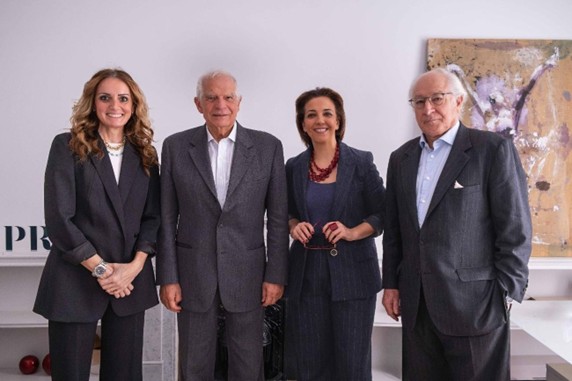
PROA Comunicación has organised a new edition of its Current Affairs Dialogues to host a meeting between business leaders and the former High Representative of the European Union for Foreign Affairs and Security Policy, Josep Borrell, who, together with the President of the Círculo de Empresarios, Juan María Nin, analysed the main geopolitical challenges facing Europe.
The international balance is undergoing a phase of profound transformation marked by armed conflicts, trade tensions and growing rivalry between great powers. In this context, the former High Representative of the European Union for Foreign Affairs and Security Policy and former Vice President of the European Commission, Josep Borrell, took part in a new Diálogo de Actualidad organised by PROA Communication, The European Commission's European Council, in which he analysed Europe's role in the new global scenario, together with businessmen, executives and institutional representatives.
During the conversation, moderated by the President of the Círculo de Empresarios, Juan María Nin, The meeting addressed some of the key issues that will shape the direction of the European Union in the coming years, from the evolution of international conflicts to the economic and strategic impact of increased defence spending. The meeting, which brought together representatives of the
The event is part of the series Diálogos de Actualidad of PROA Comunicación, a consultancy firm specialising in strategic communication, corporate reputation and public affairs. Lucía Casanueva, During the opening ceremony, the founding partner underlined the firm's vocation to contribute to the public conversation and to generate spaces for reflection where companies, institutions and civil society can exchange ideas on the major political, economic and geopolitical challenges of the moment, highlighting the importance of understanding the international context in order to be able to make strategic decisions with criteria in an increasingly complex environment.
Spain and Hungary in Brussels: the “two problems of Europe”.”
One of the central themes of the dialogue was Spain's position on the European chessboard. Asked by Nin, Borrell pointed out that, although it is true that in certain EU spheres there is a perception that places Spain as one of the two main sources of conflict within the European Union - the other being Hungary - this is a simplified reading that does not reflect reality.
“I think this comparison is unfair,” he said, referring to the comparison between the government of Pedro Sánchez and that of Viktor Orbán. To explain his position, he clearly differentiated between the two positions, stressing that while Hungary has blocked key initiatives in support of Ukraine and maintains a policy of confrontation with European institutions, Spain has always played a constructive role within the EU project. In contrast, he defined Spain's position as that of a “cricket nugget”, rather than that of an “obstacle”. Unlike others, Spain has never been scrutinised by the EU for violating the rights of its citizens“, he said.
Europe in a changing geopolitical environment
During his speech, Borrell warned that the EU faces a decisive moment in a world that is increasingly fragmented and where power dynamics are evolving rapidly. “The European Union was not designed for today's world,” he said, stressing the bloc's difficulty in adapting to an environment marked by conflicts such as the war in Ukraine, instability in the Middle East and the growing rivalry between the United States and China.
More specifically, he pointed to the lack of a single voice in foreign policy and defence as one of the main weaknesses of the European project. He recalled that, unlike in other areas of integration, these competences remain in the hands of member states, which limits the EU's ability to act as a cohesive geopolitical actor. “Kissinger used to say that he did not know which phone to call to talk to Europe. Today that phone is even harder to find”, he added.
Defence and strategic autonomy: an unfinished business
The debate highlighted Europe's structural shortcomings in defence. Juan María Nin explained why “both Europe's sovereignty and its strategic autonomy are at stake”. And Borrell pointed out that the continent still lacks a
integrated military capabilities, with fragmented systems and no single command to respond in a coordinated way to today's challenges.
“Each country is sovereign in its defence and there is no single EU defence”, he explained, recalling that not even a rapid reaction force of limited dimensions has been set up. In this context, he warned that “Europe has been, to a large extent, a protectorate of the United States since 1945”, which is evidence of the bloc's structural dependence in security matters.
However, he also underlined the contrast between the two models, pointing out that while the United States has consolidated its position as the world's largest military power, Europe has built more balanced societies in terms of freedoms and social cohesion, directing its resources towards economic development and welfare.
China, the Middle East and tensions in the international order
During the colloquium, Borrell also addressed China's role as a key actor in the configuration of the new world order, stressing that, despite its growing capacity, the Asian country maintains a prudent strategy in the short term. “China knows its economic limits and needs stability”, he pointed out, noting that he does not foresee major movements in scenarios such as Taiwan in the short term.
On the Middle East conflict, the former High Representative advocated an approach based on respect for international law, warning of inconsistencies in the position of some European countries. While acknowledging the authoritarian nature of the Iranian regime, he stressed that “from there to justifying intervention, as it is being carried out, there is a step”. He recalled the precedent of the Iraq war and the need to maintain consistent criteria in external action.
The meeting, held in a closed format and by invitation, brought together businessmen, executives and institutional representatives from different sectors, who participated in a subsequent discussion with the speakers to exchange views on geopolitics, international trade and the economic challenges arising from the new global scenario.
The session is part of the cycle Current Affairs Dialogues PROA Comunicación, conceived as a space for conversation and reflection with some of the main voices of public debate on the political, economic and strategic challenges that will mark the future of Europe and the international system.