
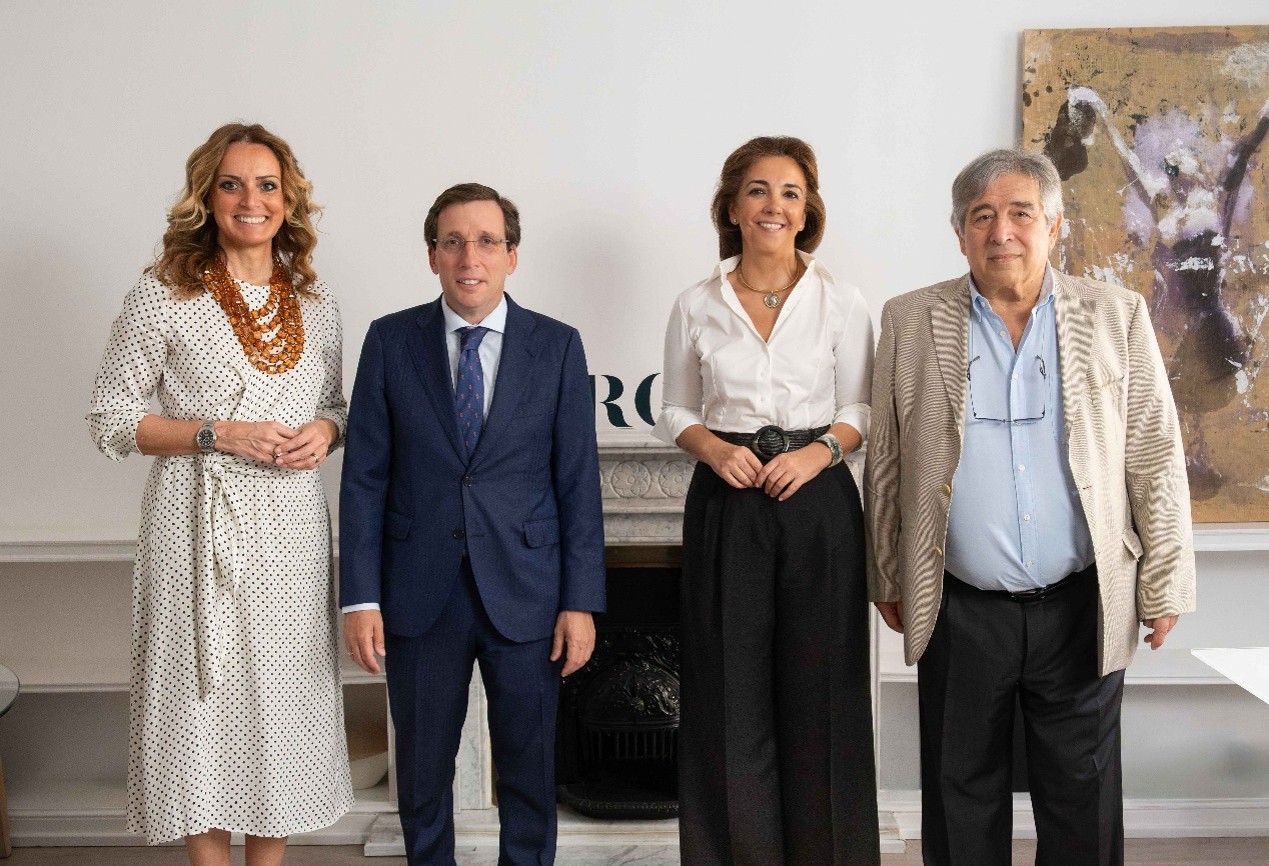
PROA Comunicación has organised a new edition of its Current Affairs Dialogues to bring together business leaders and executives with the Mayor of Madrid, José Luis Martínez-Almeida, who, together with political analyst Ignacio Varela, analysed the main challenges facing the city and the political and economic context in Spain.
The Mayor of Madrid, José Luis Martínez-Almeida, has taken part in a new edition of the Diálogos de Actualidad de Madrid (Current Affairs Dialogues). PROA Communication, where, together with political analyst Ignacio Varela, he analysed the Spanish political situation, the debate on a possible motion of censure, the future of the institutions and the challenges facing Madrid and Spain. During the meeting, the mayor also ruled out abandoning municipal politics to make the leap to national politics.
During the opening of the meeting, Lucía Casanueva, managing partner of PROA Comunicación, pointed out that “in order to be able to defend the interests of the companies, associations and employers” associations that place their trust in us, we must be an active part of the public debate", stressing the importance of generating spaces for reflection that allow us to understand an increasingly complex political, economic and social environment.
Governments and “Frankenstein” motions”
One of the highlights of the dialogue came when addressing the national political scenario and the debate on a possible motion of censure of the current government of Pedro Sánchez. Asked about the demands of Junts, which have been reported in the press in recent days, Almeida rejected the possibility of articulating an alternative based on exceptional formulas or instrumental candidates and affirmed that “neither Frankenstein governments work nor Frankenstein motions of censure are going to work”.
In this sense, he defended that any initiative of this type should be developed within the ordinary channels, with Alberto Núñez Feijóo as a candidate, and maintained that “Junts should not be the one to dictate what has to happen”. Furthermore, he pointed out that it is up to the main opposition party to assume the responsibility of leading any political alternative that may arise in the current context.
Your political future
Asked about the possibility of making the leap to national politics in the future, perhaps as a minister, Almeida ruled out abandoning the mayor's office in Madrid and assured that his priority continues to be the management of the capital.
The mayor recalled his previous experience in national politics, from which he claimed to have emerged “scalded and almost dead”, and assured that he is fully committed to the municipal project. In this sense, he insisted that his intention is to continue at the head of the City Council and to continue developing the city project that he started eight years ago.
Institution building and reconstruction of majorities
During the conversation, Almeida reflected extensively on the current political climate and warned of the risks generated by a dynamic of permanent polarisation. In the face of this, he argued that an eventual political alternation cannot limit itself to reproducing the same practices that he criticises.
“We cannot come here to do the same thing”, he said, referring to the need to avoid a mere substitution of actors who dedicate themselves to “expansively occupying the institutions”, and instead he advocated the strengthening of the institutions and the recovery of their independence and credibility.
Along these lines, he criticised one of the PSOE's main strategic errors in recent years as having given up on building large social majorities in order to settle for being a “blocking minority”. Against this, he defended the need to articulate projects capable of bringing together broad majorities around a shared framework of coexistence and institutional stability.
Housing, institutional cooperation and social cohesion
Access to housing was also an important part of the debate. Almeida agreed that this is one of the main concerns of citizens and argued that its solution requires effective cooperation between administrations, criticising the lack of institutional coordination in key areas such as housing, transport and urban rehabilitation.
At the same time, he warned of the risks faced by large cities in contexts of strong economic and demographic growth. In the case of Madrid, he identified the preservation of social cohesion as the main challenge, guaranteeing that economic progress translates into real opportunities for all citizens.
In this respect, he defended the importance of keeping the social lift active, facilitating access to educational and professional opportunities for all Madrilenians and ensuring homogeneous standards of public services in all the city's neighbourhoods.
Madrid as a global city
The conversation also addressed the evolution of Madrid as one of the cities with the greatest capacity to attract talent and investment in Europe. Almeida highlighted the combination of economic opportunities, quality of life and personal freedom as some of the main differentiating factors of the capital.
In an international context marked by polarisation and social fragmentation, he argued that Madrid must continue to be an open, welcoming city, capable of integrating people of different origins, sensibilities and life projects.
The Mayor also highlighted the role of culture as one of the city's main strategic assets and underlined the importance of continuing to strengthen Madrid's international projection from an economic, cultural and social perspective.
The meeting brought together businessmen, managers and institutional representatives from different sectors, who then took part in an open discussion with the speakers to exchange views on the Spanish political situation, institutional challenges, the development of major cities and the country's economic prospects.