
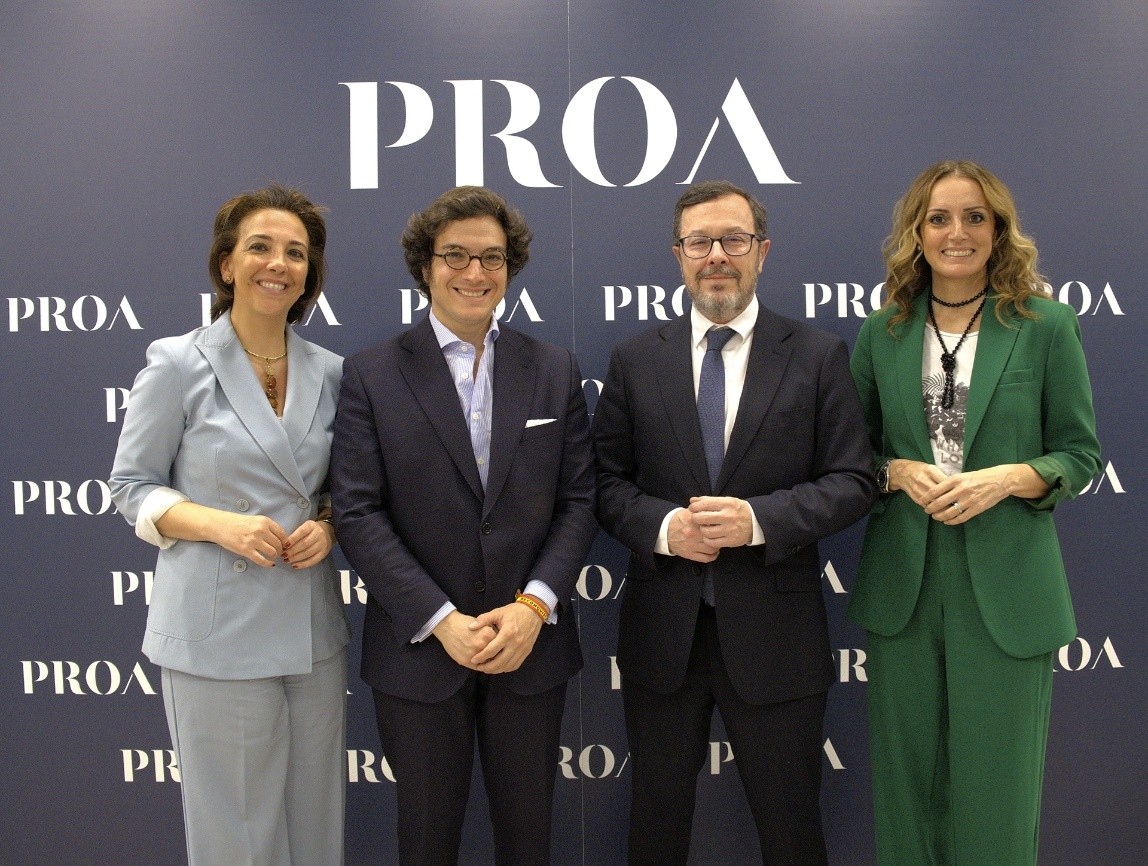
PROA Comunicación has organised a new edition of its Current Affairs Dialogues, bringing together businessmen with José María Figaredo, spokesperson for Economy, Energy and Deregulation of VOX in the Congress of Deputies, to analyse the economic situation in Spain.
Political stability and the evolution of the Spanish economy were the focus of a new edition of the Diálogos de Actualidad of the Spanish media. PROA Communication, The event was attended by José María Figaredo, spokesperson for Economy, Energy and Deregulation of VOX in the Congress of Deputies.
Asked during the debate with businessmen, Figaredo acknowledged that he considers it “difficult” to reach a legislative pact with the Popular Party, which he accused of “reneging on its own programme” when negotiations begin. He explained that, in his experience, the main obstacle does not lie in the will to dialogue, but rather in the fact that the PP “fails to fulfil” previously signed commitments, placing his party in the position of choosing between “submission” or “the appearance of intransigence”. In his opinion, political stability requires programmatic coherence and compliance with agreements in order to be able to offer institutional and economic certainty.
During the opening of the event, the managing partner of PROA Comunicación, Lucía Casanueva, underlined the importance of generating spaces for conversation between the business world and the main players in the public debate. “In order to defend our clients” interests judiciously, we must be an active part of the public debate and listen, make people listen and debate with those who lead it", she said, highlighting the value of these meetings to analyse the country's economic and institutional challenges from different perspectives.
Macroeconomic growth and loss of purchasing power
Beyond the political level, Figaredo focused a large part of his speech on questioning the government's economic narrative. In his opinion, the macroeconomic data provided by the government “are either lies or are grossly distorted”, insofar as GDP growth does not reflect the economic reality of families.
The economic spokesman argued that the increase in GDP is largely due to population growth in a context of a low birth rate, while indicators such as GDP per capita and the consumption of basic goods show, he said, a loss of purchasing power accumulated over the last three decades. “More indebtedness, more tax collection and less productive investment translate into less well-being for Spaniards”, he summarised. In this sense, he argued that economic analysis should incorporate indicators linked to disposable income and the real savings capacity of households.
Infrastructure and energy system
Figaredo also warned of the progressive deterioration of strategic infrastructures. He pointed to recent problems in the electricity system, the state of the railway network and road maintenance as examples. “In Spain, things are beginning to fail that we in the West had never thought could fail,” he said.
On energy, he defended strengthening the electricity system through greater investment and a mixed model that guarantees stability and security of supply, with special mention of nuclear energy. He also warned that an unstable system could exacerbate inequality, as large companies can protect themselves with their own resources while households and SMEs are left exposed. In his opinion, energy policy should be oriented first and foremost towards ensuring the security of supply and industrial competitiveness.
Housing and reindustrialisation
Access to housing was another of the central themes of his analysis. Figaredo described the situation as “disastrous” and attributed the problem to a combination of supply restrictions - due to administrative obstacles, land shortages and regulatory difficulties - and an increase in demand concentrated in certain urban centres.
He also advocated facilitating peripheral reindustrialisation as a way to deconcentrate population and economic activity, and advocated a deregulation agenda aimed at reactivating supply, improving productivity and territorially balancing growth.
Reform agenda
In response to this diagnosis, VOX's economic spokesperson proposed a reform agenda based on deregulation, the reduction of certain taxes - including a proposal to reduce VAT from 21% to 18%, which he estimated at some 14 billion euros per year - and a review of the current labour framework, with special attention to absenteeism and productivity.
On pensions, he argued that a “deep and traumatic” reform will be necessary and will require a significant budgetary effort over a prolonged period. He proposed moving towards a mixed model that combines a guaranteed non-contributory minimum with a contributory component linked to a fund that generates returns, and stressed that any changes should be applied gradually and not retroactively. The aim, he explained, would be to strengthen the sustainability of the system and reduce its structural dependence on public debt. “The situation is disastrous; either we do a 180º turnaround or we are dead,” he concluded.
Governance and programme coherence
Asked again about the possibility of a legislative agreement with the PP, Figaredo admitted that he does not know if it will be possible and reiterated that the difficulties lie, in his opinion, in the fact that the PP have renounced in previous negotiations to measures included in their own electoral programme. As an example, he mentioned their refusal to reduce taxes on nuclear energy.
The MP defended the fact that VOX has abandoned regional executives with the PP in order to preserve its coherence and credibility, even assuming the political and personal cost of this decision, and argued that institutional stability requires clarity and compliance with the commitments made.
The meeting, held in a closed format and by invitation, brought together businessmen, executives and institutional representatives from different sectors, who participated in a subsequent discussion focused on business competitiveness, political stability and the regulatory environment. The session was part of PROA Comunicación's Current Affairs Dialogues series, conceived as a forum for reflection that brings together political, economic and institutional representatives to analyse the country's main challenges.